Quantum Computing for Beginners: Explained in Simple Words (2025 Guide)
Overview
1. What Is Quantum Computing? 🧠💻
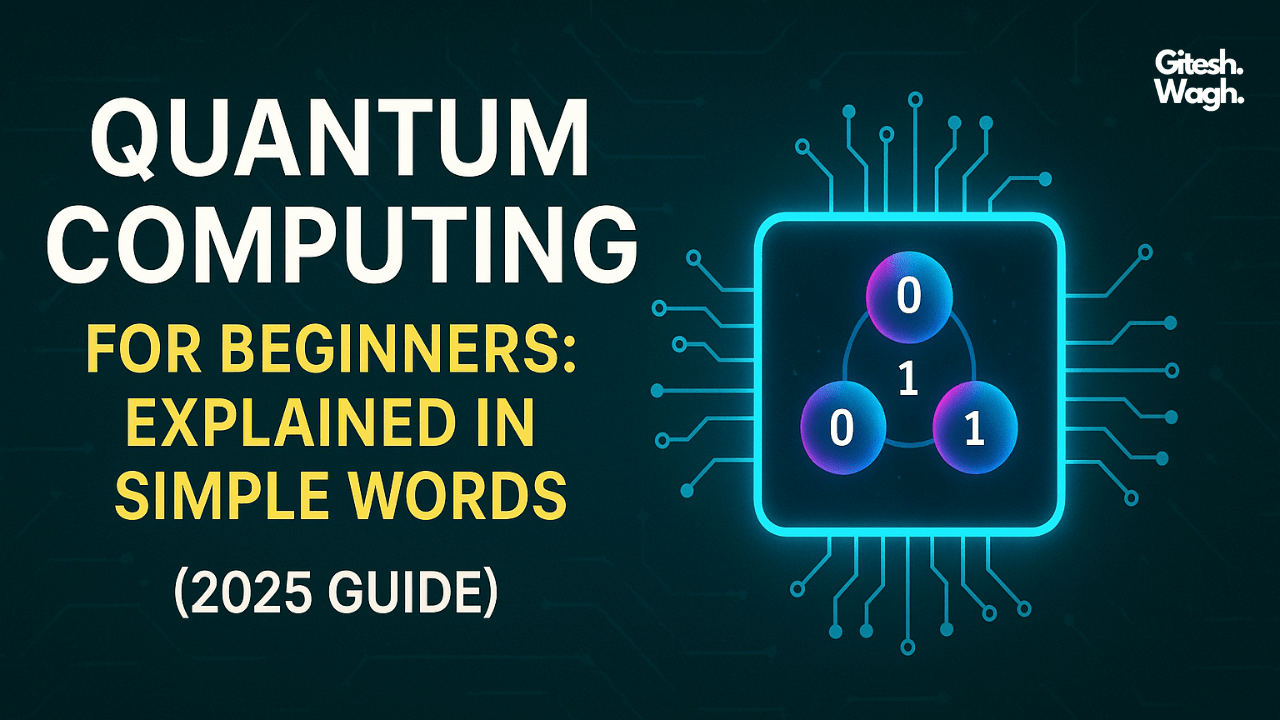
Quantum computing is a new way of processing information. While regular computers use bits (which can be either 0 or 1), quantum computers use qubits—special bits that can be both 0 and 1 at the same time. This strange ability is what gives quantum computers their power. Think of it like flipping a coin—while it’s spinning, it’s both heads and tails at once. That’s how qubits behave.
2. Core Concepts Made Simple 🧩
To understand quantum computing better, let’s break down a few basic terms:
| Term | Simple Meaning | Analogy |
|---|---|---|
| Qubit | A quantum bit | A spinning coin that’s both heads and tails |
| Superposition | A qubit can be in multiple states | Like multitasking many outcomes at once |
| Entanglement | Two qubits are connected instantly | Like twins who feel the same emotion from far away |
| Quantum Gates | Operations that change qubit states | Like switches or instructions in normal computers, but smarter |
These features let quantum computers explore many possibilities at the same time—something normal computers can’t do.
3. Classical vs Quantum Computers 🌍
In a regular (classical) computer, problems are solved step by step, one at a time. In contrast, quantum computers can solve many possibilities at once, thanks to superposition and entanglement. For example, if you wanted to find the shortest path between 100 cities, a classical computer would try one path after another. A quantum computer could try all paths at once, saving a huge amount of time.
4. Real-World Applications of Quantum Computing
Quantum computers are not just cool science experiments—they have real uses in the world:
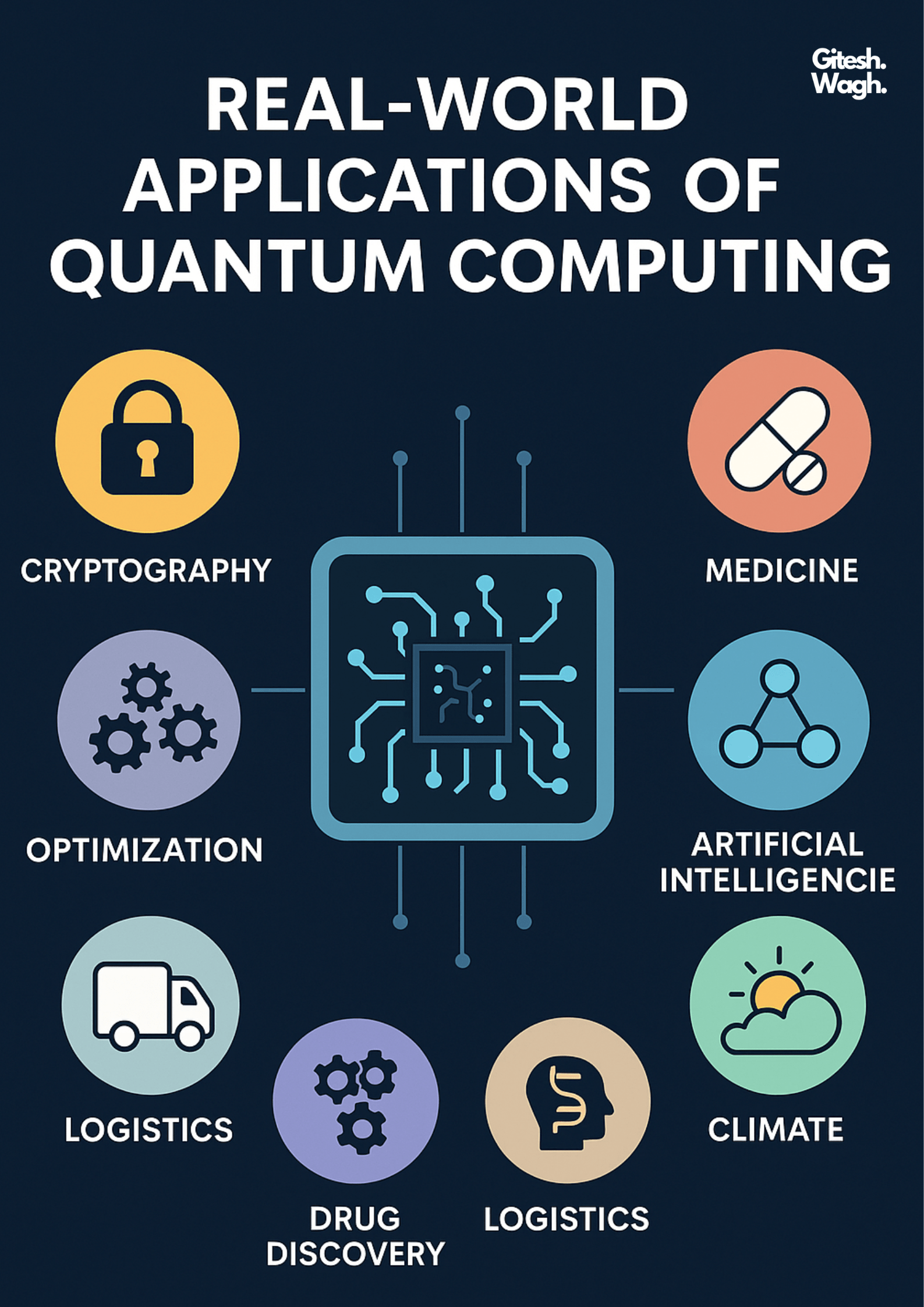
- 🔐 Cryptography: Quantum computers can crack existing codes or build ultra-secure systems.
- 💊 Medicine: They can simulate molecules to discover new drugs faster.
- ☁️ Climate: Simulate complex weather patterns more accurately.
- 💸 Finance: Analyze huge data sets and predict market trends.
- 🤖 AI: Speed up machine learning by trying more combinations at once.
These technologies are still developing, but their potential is game-changing.
5. Current Limitations & Challenges (as of 2025) ❄️💸
Quantum computing is powerful, but not yet ready for everyday use. The computers are very expensive, and they must be kept at extremely cold temperatures (near absolute zero). Also, quantum systems are very fragile—qubits can easily lose their data due to noise or interference. These challenges are why we don’t have quantum laptops yet.
6. The Future of Quantum Computing 🔮
Big tech companies like Google, IBM, and Microsoft are investing billions in quantum computing. They're working to achieve something called "Quantum Supremacy", where quantum computers outperform classical ones in real tasks. In the next few years, we can expect breakthroughs in AI, materials science, and cybersecurity—all powered by quantum computers.
7. Should You Learn Quantum Computing? 🧑🎓
If you’re interested in Computer Science, Physics, or Artificial Intelligence, then yes—this is a great field to explore. There are free beginner platforms like IBM Qiskit, Microsoft Azure Quantum, and courses on Coursera and edX. You don’t need to be a scientist to start learning—just a curious mind and a love for future tech.
8. How Quantum Computing Affects Cybersecurity 🔐
One of the most talked-about effects of quantum computing is on Cybersecurity. Today’s encryption systems, like RSA, rely on mathematical problems that are hard for classical computers to solve. But quantum computers can solve these problems much faster. This means that once powerful quantum computers are available, many current security systems could become breakable. That’s why researchers are now working on quantum-safe encryption methods, also known as post-quantum cryptography, to protect future data.
9. Can Quantum Computing Help AI?
Yes! Quantum computing and Artificial Intelligence (AI) can work together to make machines smarter. AI algorithms often require searching through large amounts of data or testing many combinations. Quantum computers can handle many possibilities at once, making this process much faster. This could help train AI models more efficiently, solve optimization problems in seconds, and even improve decision-making systems in robotics, finance, and healthcare.
10. Where to Start Learning Quantum Computing (Free Resources) 📚✨
You don’t need a physics degree to start learning quantum computing. Here are some beginner-friendly platforms you can explore right now:
- IBM Quantum Experience: Free cloud access to real quantum computers.
- Qiskit.org: IBM’s open-source platform with tutorials and projects.
- Microsoft Learn – Quantum: Beginner courses using Q# (Quantum programming language).
- Brilliant.org: Interactive lessons on quantum computing basics.
- YouTube Channels: Like “Two Minute Papers”, “Kurzgesagt”, and “Qiskit” have easy-to-follow videos.
Start small, be curious, and don’t worry if things seem weird—quantum computing is all about thinking differently.
11. Conclusion 🚀
Quantum computing is one of the most exciting areas in technology today. It’s not science fiction—it’s science fact. By understanding the basics now, you can be part of the future that will use this amazing technology. Whether you’re a student, a developer, or just curious, quantum computing is something worth learning in 2025 and beyond.